Sunday, January 14, 2024

Make Today Beautiful -- by Sarah Schra

 It's been my experience that you can nearly always enjoy things if you make up your mind firmly that you will.  

- Lucy Maud Montgomery

Morning in Vanuatu is filtered sunlight, a full bird chorale and thick hot air. Either rain or steam radiates from the wild dense jungle, pleasantly scented by hyacinth and bougainvillea flowers, coconut and plantain trees. Even on an overcast day filled with rain showers, the air is warm and the birds still loudly welcome the morning. This cacophony of light and sound makes it impossible to sleep in.

Today was no different. I rose early, went for a miles-long walk, expecting to have a cup of coffee, a shower, and maybe a nap and a swim when we got back to our home base. Island calendars are always in flux. When I arrived back sweaty and tired, I discovered we were leaving straightaway to go into town to purchase supplies for our community service project. I'm generally flexible, but the combination of the humidity, heat, and exhaustion from the previous days had put my attitude in a sour place. I really wanted a cup of coffee and a shower at the very least. The ability to flex and adjust, and to give when needed is an absolute necessity in this culture. So, choosing adventure, showerless and uncaffeinated, I rode into town with our crew and the representatives from the Pango Kindergarten.  Aaaand it started raining!

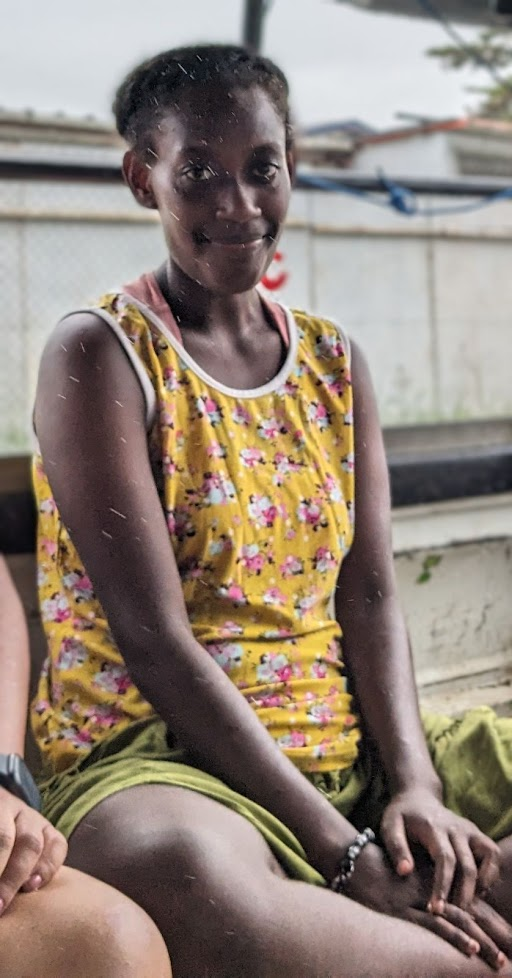
Aroalyn (aka "Aruha"), the 20yr old teacher in training and daughter to the head of school, rode into town with us and we developed an immediate rapport. She spontaneously gifted me a bracelet from her wrist, and in return I gave her the rainbow band from my finger which I had purchased at LAX to replace the wedding ring I had left at home.  This small exchange on a bumpy dirt road warmed my heart and is a core memory from our time on the island. Aruha's warmth and generosity in that moment represents the best of the island, even amidst poverty and hardship. 

 The kindergarten was started by Aruha's grandmother, a retired teacher who saw a need in her community for the little ones to learn to read and write before they could attend the local elementary school. Aruha's mother eventually became head of the kindergarten, and now Aruha is studying to assist her mother and eventually take over the school someday. She has a joy-filled smile, and a spark of mischievousness that only endeared her to me further. Her young neices came along with us, and it was fully evident they adored her as well.


Once we arrived at Wilco, the Port Vila equivalent to our Lowe's or Home Depot,  we hunted down paint and rollers, paintbrushes for the mural we were planning to paint, and priced the new ceiling materials.  


The two younger girls who came to town with us followed Emily all around the store, calling her "teacher, teacher" and helped to pick out brushes, and selected a soft pink and vibrant purple color of paint to use in the mural. The twinkle in their eyes and the way Emily embraced their eager assistance was another bright moment in the day. 

I noticed that the customers in the store were mostly men, but there were also several women in the store purchasing building supplies. The women shopping in the store primarily wore t-shirts and skirts in lieu of the traditional island "mama dress", but there were a few who wore the mama dress. (More on the Mama Dress in a future post). 


On the way home we stopped at a Deli and then went back and cooked a large family meal of roasted chicken, rice, and vegetables. It was delicious, and just what the doctor ordered for those in the group who were struggling to adjust to island food. Dinner conversations with the group always shift to impressions of the day, the island as a whole, what we are reading, and how to reconcile individual rights with the collectivism inherent in Vanuatu culture. I look forward to this time of day and space it provides to reflect and hear other perspectives. 


Making one's mind up that you will embrace the day, whatever it may bring, and choose to squeeze the joy out of it is a life skill that I will continually need to practice. It does not come naturally to me, but when I am successful at it, it truly makes a difference in my attitude and the attitude of those around me, and often grounds and connects me to each moment in a way I would otherwise miss out on. The continuous flux of life in a third-world country offers a unique opportunity to challenge and grow this skill in a way our western bulleted lists and exact times for meetings, classes and plans never could. Our western culture does not force us to shift gears or readjust our expectations nearly as often. As future attorneys, the ability to flex, shift, and take a different route while preserving our good attitude is an invaluable skill that will greatly benefit our future clients. 

Tuesday, January 9, 2024

Snorkeling, Salsa, Sea Turtles, and Scuba Diving: A Day of Firsts - by Emily Almeida

  In this life, we are presented with countless opportunities to take the world by the reins and try new things. It is our response to those opportunities that can change our lives, that can create memories that will last a lifetime and alter our perspectives forever.


On Sunday, January 7th, our group was faced with this reality, and we came away with countless memories and an appreciation for new hobbies. In the early morning hours, we split into two groups. Andrew and Elise went on a diving excursion and the other six members of our crew in Vanuatu got onto a bus to head towards the dock for our day of sailing and snorkeling.

 While Andrew and Elise explored the depths of the ocean on one side of Vanuatu, the rest of our group was delighted to be sailing with our Captain, who was also the Senior Magistrate Judge in Port Vila, Moses Peter. Moses graduated law school in 2010, and his application to become a judge was accepted a few weeks later. Moses has been working in the magistrate court for the last 13 years and was invested with the Senior Magistrate title in 2015. As a judge he presided over many domestic violence cases and was a council member in the South Pacific Conference on Youth and Children’s Court. He was the perfect captain for our ship of students studying the rights of women and children in Vanuatu.

In between our snorkeling breaks, we asked him questions about his time in law school and his work as a judge. He shared with us that law school in Vanuatu is a four-year process, and that, to become a judge, all that an applicant needs to complete is a paper application stating interest, after which they may be selected. We also learned that the lifecycle of a case in Vanuatu can be incredibly long because of all the filing requirements and the remote nature of the country. For legal issues in Port Vila, cases may move faster, but for issues on more remote islands, the case may be pending for years until the court makes its rounds to that island.

Moses also spoke with us about the plural legal system here in Vanuatu. Vanuatu is unique in that it is one of the only truly plural legal systems, in the sense that there are two distinct recognized conflict management devices. There is kastom, which is the historical method of conflict management that became ratified in the Vanuatu constitution and penal code upon Vanuatu’s independence, gained in July of 1980. Kastom is a legal system handled by the chiefs of every village and is best described as an expectation placed on the members of villages to act a certain way in conjunction with the values of the community. The other legal system is our traditional view of ‘law’, a formal system set up by the State that engages in criminal and civil cases. Though ‘kastom’ has been generally recognized by law and is to be honored in certain aspects of a legal proceeding (for example, in determining damages, the value exchanged under kastom at the direction of the chief must be recognized), there is no one definition of kastom. Kastom changes from village to village, and while there are overarching themes, the legal recognition of all kastom practices creates an avenue for certain actions to be excused as kastom to justify an act that would otherwise be seen as a serious transgression.

An example of kastom is the concept of ‘bride price’, which is the exchange of value from a man to a woman’s father in return for the man taking the daughter as his wife. The value is capped at 80,000 vatu, or just under $700 USD. Though the bride price was originally intended to be given in thanks for the family raising the daughter for the man to marry, it has become distorted over time, and is now used as an excuse for men to do what they like to their wives under the justification of it being permitted under kastom. Moses explained to us how the excuse of kastom in court can complicate legal proceedings, and, if not handled carefully, can lead Ni-Vanuatu to lose faith in the legal system of conflict management, writing it off as an effort to erase kastom, the cultural backbone of Vanuatu.

Our conversations with Moses were incredibly enlightening- we were so lucky to have him as our captain! He agreed to take a picture with us after we finished sailing.

Our boat trip wasn’t just speaking to Moses - we also made stops to snorkel and explore! Our first stop was tranquility island, home of the Tranquility Island Resort Turtle Rookery, which raises Hawksbill turtles from hatchlings to 1 year old, in the hopes of lowering the likelihood of death and giving them a better chance to reach breeding age.

After a brief history of their work at this preservation center, we were given instructions on how to clean our hands and safely handle the turtles, and then we were given the opportunity to interact with sea turtles at different stages of their lifecycle.


It was an outstanding opportunity, and the ethical treatment of these endangered sea turtles made the experience even more meaningful.


After our stop at Tranquility Island, we went snorkeling at three different spots. At the first point, a few of us swam alongside a nursery shark, while others explored the coral reef and various species living just underneath the water. The second stop gave us the opportunity to swim with a school of fish, watch flying fish as they jumped above the water line, feed fish small pieces of bread, and watch some sea turtles in the distance. Our final stop allowed us to look at giant clams and enjoy the water one last time before returning to the shore.

At the end of the day, over a bowl of salsa and with our group reunited, we shared our ‘highs’ for the day, spoke about our different experiences, and realized that we had all tried at least one thing for the first time that day. It was a valuable day of learning and fun, and created memories that will last a lifetime.

Vanuatu Salsa Recipe:


1.     Travel to Top Rock, just north of the Blue Lagoon, and buy two mangoes. Let them sit on the counter for two days to get ripe.

2.     Go to the local deli and purchase one white onion.

3.     At Au Bon Marche, buy a bag of garlic. (It’s not sold by the individual head of garlic, but rather a bag of roughly 15 heads for 450 vatu. You only need four cloves of garlic, but this step is mandatory).

4.     Travel to the Mama Market downtown and buy one medium pineapple, two pounds of tomatoes, a bowl of sweet peppers, and a bowl of small limes, for a grand total of less than 1,000 vatu.

5.     Dice the tomatoes, ¼ of the onion, about a handful of the peppers, and four of the small limes. Cube the mangos and ¼ of the pineapple. Mix together, then add the juice of four of the limes.

6.     Serve alongside whatever tortilla chips you can find to a group of almost-strangers-become-close-friends, preferably with a side of reminiscing over your time exploring Vanuatu, learning about local law, and becoming familiar with a once unfamiliar culture. 

"Sefti, digniti, rispek mo gud fasin blong evriwan" ( Safety, dignity, respect and proper treatment for all ) by Jana Baker

Vanuatu Department of Corrections 

Trying to describe what it is like waking up in Vanuatu is like trying to describe a dream because you are truly waking up in paradise. Our villa sits on a beautiful beach looking out at the South Pacific Ocean providing the ultimate view of picturesque clear blue waters, white sand, and tropical landscape. Each morning I wake up and enjoy a cup of coffee or orange juice on our deck only steps from the beach. As I journal, I hear the birds chirping, the wind whispering through the trees, accompanied by the waves crashing along the shore orchestrating the perfect symphony.

With such beauty in every morning, it is hard to imagine that Vanuatu offers anything less than the perfect paradise I have grown accustomed to, but darkness is always lurking beyond the brightness. In the shadows beyond the tourism, beautiful beaches, and smiling faces, there is a lot of violence and crime. The legal system in Vanuatu integrates both English common law and indigenous customary law. Rather recently, in 2006, Vanuatu introduced “Dipatmen Blong Koreksenol Sevis” which provides correctional services to the country. Typically, all services are shut down during the holidays, but because of Professor Buske’s local connections, we were lucky enough to tour the correctional facilities today. 

The most incredible part of studying abroad in Vanuatu is the opportunity to learn in everything you do. We typically begin every day that we spend away from the villa with a 20-minute or so bus ride into downtown.  During the journey, we have had the opportunity to meet so many different NiVans (locals) and even just local patrons who are  riding the same bus – and by bus I really mean van.  As we were leaving, the 3-year daughter of George, the villa groundskeeper, was clinging to someone and terribly upset and crying.  We learned that the man was her “Small Father” (or as we would say stateside, her uncle) and he was leaving. It is the little moments like this that open the authenticity of this experience. We learned that he is only on the island three months out of the year as he goes to Australia for the Odyssey Program (9 months out of the year he is over there picking fruit and such). This is just a small example of the culture we have merged into in just a simple daily thing we do. 

As we rode the bus into town to visit the Medium Security Centre, which also includes their high-security unit, someone made a joke about the eeriness of asking the bus to drop us off at prison, but I imagine it may be a more common request than we think.   

The facility was surrounded by barbed wire and there was a guard at the gate.  Once we were finally allowed to enter, we were taken to a small shed-like building with open windows where we met Principal (warden) Timothy, a new friend I think we are all grateful for. Here in Vanuatu, there are village chiefs and there are also courts. These two legal systems can work together. Timothy, the bloodline of a chief, is a very educated man. He went to school to be an accountant and while he worked at his office on the hill, he watched the cruise ships entering the port. He decided he wanted more and became a chef, allowing him to travel the world working on cruise ships. Eventually, he returned to Port Vila, Vanuatu, and joined the Corrections Department and worked his way from Officer to Principal. Timothy is close to retirement; he is currently 43 and will retire at 45. You could see his excitement about retiring, but also the pain of leaving behind his job. Timothy was very generous with his time - he answered all our quesitons in great detail. One very noteworthy thing to mention about Timothy is the eye contact he made with every single person in our group. Often, we have noticed men here will not make eye contact when speaking to the women of the group, but Timothy held eye contact allowing us to see the depths of kindness behind his eyes. 

The Vanuatu Criminal Justice System mirrors many components of the American Criminal Justice System, likely because they are both based on English Common Law. In Vanuatu, when an offense occurs, the court must issue a warrant for a perpetrator to be taken to the prison, where they remain until the investigation is complete. Once the investigation is complete, a person may get bond until their sentencing occurs. The courts use a database similar to the ones we have in the states that help calculate a sentence. Once the individual is sentenced, oversight and control of the perpetrator shifts from the court system to corrections. It is up to the Principal to decide when a person can move from medium security to lower security. 


Prisoners can apply for parole through the parliament parole (courts) or the presidential parole.  Both routes require the recommendation of the Principle.  In preparation for a parole hearing, correction officers closely watch inmates to determine whether they have truly changed their ways.  The parole and process for moving to lower security seems very similar. The Principal will talk to the members of the community including their pastor and chief to get a better idea of who the person was before they arrived at the facility. They will see if the offender takes responsibility for his offences and will usually consider the victim’s input. The Principal then decides whether they have really learned from what they did. That seems to be the theme and purpose of corrections in Vanuatu – giving them time to learn from what they did and truly change. While some people still believe that prisoner's can't truly change, one big difference from the American system is that there is no shaming here and they give offenders a chance in society again. For example, there is no sex offender registry for communities to see. 


There is recent legislation requiring juvenile offenders to be held separatly from offenders, but there's been no real progress in actually building a facility due to lack of funding.   The new legislation requres that anyone under 18 must be separated from adult -- even if they are only 2 months from turning 18. This is because it is really dangerous for juveniles to be mixed in with adults -- the majority of whom are sex offenders.  For juveniles, jail is the last option. The Court and villages will work together to try and teach the juveniles and whether they learn or reoffend determines whether they are on the prison pathway. Most juvenile offenders are those who do not live with their parents and often live with their grandparents. Most of the crimes that juveniles commit are theft crimes. There are more Gangs forming and graffiti has recently begun popping up.

There are currently 13 offenders in the high-security unit and about 57 in the medium-security unit.  Principle Timothy explained that 85-90% of the prison population has committed some type of sex offense, and about 50% of the time the victim was a family member. About 2% of the population is there for theft. The high-security unit no longer has toilets because inmates damaged them. The cells are metal shipping containers with latches on the outside to keep the inmates in. Our visit occurred during lunchtime and we were able to observe that process. For me, as an abolitionist to begin with, I felt uncomfortable watching the inmates during lunchtime. I watched as the guard unlatched one of the containers allowing one inmate at a time to run into the courtyard, grab their plate and run back to the cell. It reminded me of watching animals in a corral being released one by one for their grazing time – but unlike those animals who had the freedom to roam fields as they ate, the inmate had seconds to grab their plate and return to their airless metal box.  For me, this felt like observing animals in a cage and was such a sobering experience. In the States, I talk to clients in jail weekly who complain about the most trivial things – if they only knew what their life could be like during incarceration here.

Many of the inmates look to Principle Timothy like a father; in fact, that is what they call him. The “Timothy Way” of corrections consists of the idea that an inmate's time in his unit is to be isolated from the community to think about the wrongful acts committed and how to become a better person for their community. As Timothy talked with us you could see the compassion behind his telling eyes. Timothy implemented something his professor in school said “This is my kingdom; do not do what I do, but do what I say” a phrase that made him want to quit school. His father told him to learn what the lesson behind that phrase was and now it is something he uses himself. He believes rules are rules and gave an example that phone use occurs Monday and Friday and letting inmates use phones any other day teaches them nothing. Instead, he encourages the inmates to prepare themselves for when they can use the phone. It seems like Timothy does everything intentionally and believes in all of his decisions teaching a lesson thus, making him like a father. His philosophy is the time an inmate is sentenced is their time to truly change. Not all officers follow the “Timothy Way” as some believe the old fallacy “once a criminal always a criminal.” There are recidivism problems in Vanuatu which Timothy contributes to once they leave the facility they change and go back to the person they were before. Vanuatu does have a parole system which is often times heavily dependent on the chiefs and ministers of the villages. 

One big difference between Vanuatu prisons and American prisons is the ability to “check out”.  The  lower security facility is sometimes referred to as the "library" becuase, if you have the money, you are allowed toleave the facility to attend school – there was one inmate that got his master's because he was there for so long – or you can go home for a funeral. You must be able to pay your own way and pay for an officer to escort you. 

After Timothy showed us around, we were able to talk with George, the Senior Corrections Officer. George explained more about the inner workings of the facility. In his office, we were able to see the groupings of people in the medium security portion of the facility which currently has a population of 57 inmates, including one juvenile. George explained that they try to group people in cells according to share a language and will be able to understand each other. Oftentimes, because they may have brothers and uncles and people from the same villages, they will try to house them together in one cell. There is currently one ex-pat who resides at the facility in isolation because his culture is very different than all the other inmates. George told us the inmates typically eat a lot of chicken and rice or fish and rice. 


George talked to us more about why the phone usage is only two days per week.  He explained that inmates can purchase cell phones with their own money, but that the are not allowed to keep them in their cells -- instead, the facility keeps them an inmates are only given access to them twice a week.  Inmates used to be able to use their phones anytime they wanted, but because so many people were using their phones to plan escapes and talk to inmates in other facilities, phone access was reduced to  only two days per week. When an inmate escapes, the corrections officers have to stop what they are doing to find them. Now, when the inmate enters the facility, they get intake information so they know who they are and where they come from.  Now, when an inmate escapes, the officers talk to their chief and pastor before involving police, which usually works and the inmate is found in a few hours. Sometimes, the police do have to become involved. George explain that, in the past, officers often "tortured" escapees when they were captured.  However, now there is training in place to prevent that dynamic. 

Timothy was kind enough to escort us to the lower-level security center which was very different. We were able to meet the lower-level acting principal, Leslie. Leslie allowed us to tour the facility, which is currently home to 69 men. There was a bakery building where the inmates make fresh bread every day for their breakfast and a kitchen building that also has kitchen storage. 

The inmates were not confined to cells and instead are kept in an open setting with a courtyard in the middle and their cells which were open surrounding the courtyard. We were able to walk into the courtyard and shake hands with some inmates who we assumed were chiefs. One key difference I noticed is that many individuals were talking on their cell phones at this facility. The facilities try to give the inmates life skills and at the lower level facility they do woodworking and the inmates can make beautiful items. We saw a cabinet that one inmate made and will sell for money.

Next to the lower level center is the women’s center, which we did not visit but Timothy shared information about the operations. Currently, there are 5 women at the center; Timothy did not share their exact charges but said that women are often incarceraated for embezzlement, theft, abortion, and prostitution. Sometimes fathers will have to bring babies twice a day to the center to allow the mothers to breastfeed. 

After concluding the facility visits we were able to go off on our own and explore Vanuatu. I chose to explore downtown with my own ex-local tour guide, Professor Buske. We were able to check out many of the local shops and stopped into one of my favorite things I’ve encountered in Vanuatu, Jill’s café! Jill is an ex-pat who owns a popular cafe here which hosts a mini book shopm of used/dontaed books.  People can purchase books from the a bookshelf based on the honor system and the proceeds go towards helping a non-profit veterinarian. 

Following a quick tropical monsoon after a lovely day of exploring we all reconvened for “family dinner” over some delicious lentil soup. Every day at dinner we go around the table and everyone shares the high point of our day (mine was Jill’s books for dogs) and decompress all the things we learned. One nice thing about the villa (at least for me) are the random dogs that also enjoy the property. One dog typically joins us for family dinner, we named her Nala. 


This island has its beauty and the darkness that follows. Despite the copious amounts of daily violence against women and children, most locals smile and wave as we pass them on the roads.  I’m not sure how such beauty and violence cohabitate creating an island of true genuine smiles and laughter, but that is the magic behind the islands of Vanuatu.


Saturday, January 6, 2024

Driving Around Efate Island by Andrew Stephens

 If you look up things to do in Vanuatu, you will likely see a visit to the Blue Lagoon at the top of the list. It’s known as one of the most beautiful locations on the island of Efate. People flock here because it’s an amazingly beautiful swimming hole with stunning blue water in a tidal zone that has a variety of Tarzan-like rope swings and platforms to jump from. It wasn’t a matter of if we were going to visit the lagoon while staying on the island, but when. The only advice we were given by locals was to avoid going on days there are cruise ships docking in Port Vila as it can get too hectic.


We thought that was the case for today, so we booked our driver, Tasso, to take us around the island and made it the first stop of the trip. Only when we rolled into town did we realize there was a cruise ship docked in the bay. That didn’t faze us, and we weren’t deterred while seeing dozens of other buses filled with tourists headed in the same direction.


Anything that is hyped up this much always makes me weary of what it’s actually like. The pictures and reviews online made it look and sound amazing. But social media and online reviews rarely tell the full story. When we pulled up to the entrance, Professor Buske couldn’t believe how much the parking lot had expanded since her last visit a few years ago while she was living here. After we found a parking spot, paid the entrance fee of 1,500 Vatu (or about US$13), we made our way to the water and instantly saw what the hype was all about. It was incredibly beautiful. It was also incredibly busy given the size of the swimming hole. There were easily several hundred people if not more and had the vibe of Spring Break in Cancun.

Vanuatu’s tourism industry is a rapidly growing economic sector for the country. They are becoming increasingly dependent on tourist dollars to help create sustainable jobs and to infuse much needed cash into the economy. But like anything else, it comes at a cost. The cruise ships are typically filled with rowdy Australian tourists on holiday looking to maximize their limited time on the island with as much fun as they can have. A daytrip to the Blue Lagoon fits that bill perfectly and is the most popular package the cruise ships book when they come to Vanuatu.

The locals we spoke to at the Blue Lagoon seemed conflicted about it all. They realize it’s generating a lot of needed money for their villages, but they are also aware of the destruction and exploitation of their land and natural resources. There were piles of trash littered throughout the site where groups kept their stuff. People were climbing trees that weren’t meant to be climbed just so they could get the perfect photo or to jump into the water. There was a disgusting lack of respect for the space. After a couple of hours of swimming and swinging into the swimming hole, our group also felt conflicted about being there and supporting a place like this. It just doesn’t seem sustainable in the long run and the lack of respect for the space was alarming and disheartening.


We got back into the van and continued our drive around the island. While going to the next destination, we found out that our driver Tasso was in fact a Chief of his village on a neighboring island. We got to pick his brain about life here and the dual legal system of the country to learn how it works. Police in Vanuatu don’t typically get involved in minor disputes or crimes. Instead, they have the local chief of the village sort it out and decide the punishment like the way parents discipline their children when they act up. Police only get involved when there are serious violent crimes or if the offender keeps repeating the behavior after the initial intervention. Prisons aren’t a thing here like in the United States. It was fun to learn about their system and compare it to ours.

When we got to the north side of the island, we saw a sign that caught our attention. It was for a place called Top Rock that advertised another swimming hole with a lookout that also offered food options. We thought it was worth checking out, so we drove down a bumpy dirt road through a small village and were greeted by a woman working her garden. They also had a 1,500 Vatu entrance fee, but there were no other cars when we arrived. The woman gave us the rundown of the site and we made our way down the muddy trail to the swimming hole. The little cove was filled with colorful fish you could see through the water without needing to get in. Those with snorkel gear jumped in the water and we couldn’t believe how beautiful this site was. The coral was healthy, and the variety of fish looked like something you only see in exotic aquariums. It felt like we hit the jackpot and found a truly hidden gem of Vanuatu.


The contrast of Top Rock to the Blue Lagoon was striking. There were no qualms about visiting this site for anyone in the group. It was the type of place we felt good supporting, and it was clear that the money they generated from the site will go directly to the people living right there. It’s not a location that would be convenient for cruise ship people to stop at so the only other people we saw were smaller groups. As we were leaving, they had a pile of freshly harvested mangos for sale that we snagged. This seemed like a much more sustainable way for tourism to work for villages and was a really great experience.


We started to make our way back to Port Vila and invited Tasso to dinner to talk more about life in Vanuatu. We let him pick a place to eat and ended up at the Waterfront Bar & Grill. It’s situated right on the water where you can watch boats in the bay while eating your meal. It was interesting to hear Tasso’s thoughts on tourism and why he supports it because of the money and jobs it generates. It ended up being a lovely dinner and a wonderful way to end a beautiful day.

Long story short, with any new emerging industry like tourism in a country that isn’t fully set up and ready to handle it, there are going to be growing pains along the way. Places like Top Rock give me hope that smaller, sustainable operations can exist that will help the quality of life for people on the island without sacrificing its natural beauty. It feels good to find places like that and be able to support them. I am so grateful to be able to experience and enjoy the beauty and kind people of Vanuatu. Hopefully they will figure out a way to find balance with tourism and sharing its beauty with travelers as its only a matter of time before the rest of the world discovers how amazing this place is.


Thursday, January 4, 2024

Our New Year Celebration in Vanuatu - by Emily Almeida

 On December 31st, 2023, at 5am in Salem, Oregon, our crew in Vanuatu watched the clock turn to 12am on January 1st, 2024, and celebrated the beginning of a new year. 

The start of our New Year’s Eve celebrations began a few hours prior when we arrived at The Beach Bar. The Beach Bar is a local restaurant owned by an Australian expat (for those who don’t know, ‘expat’ is short for expatriate, someone who lives and/or works in a country other than their country of citizenship). The Beach Bar is popular for its Friday night fire shows and Sunday night circus- and, as a special treat for New Year’s Eve, The Beach Bar hosted a fire show and fireworks display, even though it wasn’t a Friday.

The Beach Bar is also well known for its pizza oven, which many of us took advantage of, ordering anything from a four-cheese pizza to a fish pizza with the local catch of the day and chunks of crab on top. (That’s island food for you!)

After we had all finished our dinner, we explored the beach and got ready for the fire show. Personally, I enjoyed watching everyone playing in the water and running around the beach. The playful attitude of all the families set the tone for the night and, in my opinion, made everything all the more enjoyable.

Eventually the music started, and everyone was told to take their seats for the fire show. The fire show was hosted by Wan Smolbag, a theater troupe of Ni-Vanuatu (the name for locals in Vanuatu), which was created in response to the need for job opportunities across Vanuatu. The Beach Bar was the first location to hire the group for the fire show, and it has since grown and gained popularity around the island.

The show started with Moves Like Jagger, (which Professor Buske immediately proclaimed to be the “National Anthem” of Vanuatu) and was followed by Firework by Katy Perry (another Vanuatu song) and many other mid-2000s pop hits (which were all deemed Vanuatu songs by our professor). Throughout the show, the troop members of Wan Smolbag danced with different tools that created various effects and shapes with the fire.


It was an incredible show, and after a small dance break, they invited the crowd to try spinning fire. In my opinion, trying new things is the PERFECT way to celebrate the new year. So, with that in mind, I OBVIOUSLY had to try my hand at something I'd never done before - spinning fire!

Before we knew it, the night was over, the year was 2024, and we were greeting the morning of January 1st with an excited attitude, ready to go into town and start the year right.

… So much for that plan! Here in Vanuatu, January 1st is a holiday for everyone- which meant that almost all of the markets and stores downtown were shuttered, giving families the opportunity to celebrate the new year together. We split into groups to explore, and while one group went to get Thai food, my group spent some time walking around the deserted downtown before we finally decided to start our journey back to the villas, via a quick stop at Au Bon Marche (the local grocery store chain here that has become a favorite of our little group). After perusing the ceramic aisle and grabbing groceries for our family-style dinner, our group went back to our villas, where I took a snorkeling and journaling break before my roommate Jana and I started cooking.

We ended the first night of 2024 around a dining table, sharing in a home cooked meal and reminiscing about our trip so far. Could there be a better way to start the year? 

Monday, January 1, 2024

Journey to the South Pacific --- by Elise Koletar

Just two days after Christmas and a mere week and a half after the conclusion of fall semester finals, seven Willamette law students and one Willamette law professor met at PDX airport prepared to embark on a two-and-a-half week study abroad trip to the other side of the world. Vanuatu would for me, be the farthest away I have ever traveled. Over 6,000 miles, and 19 hours ahead from our home in Oregon, after we completed the 28 hour journey, this group of 8 unlikely friends would have time traveled and be living a day ahead of the rest of our friends and loved ones left behind in Oregon. 

From the outside, this group could not appear to be more different. Different ages, different backgrounds, different ethnicities, career backgrounds and aspirations, different styles. What this group has in common is that for 8 different reasons, they each decided to attend the Willamette College of Law, and for 8 different reasons, we each decided that traveling to a tiny island in the South Pacific to study international children's rights was an opportunity we could not pass up. So, our little group gathered together at the gate. As I looked around I took a moment to marvel at my certainty that this troop of at-best-acquainted students would be returning bonded in a life-long way that at the time I had no way of fathoming. 

"Each morning we greet the sun with joy and happiness that we are the first in the world to see the day" - Taxi driver; Nadi, Fiji

If you ever must endure a 9-hour lay over, I highly recommend you take it in Fiji! We left the airport, felt sun on our skin for the first time in several months, and enjoyed a breakfast of chips (french fries) on the beach. After the layover, we finally boarded an ATR 72-600 (aka- a rather small propeller powered plane) to make the third and final leg of our journey to Port Vila, Vanuatu. 


Our plane took a sharp u-turn and as it did the island of Vanuatu came into view. The sun was hitting the hills leaving beautiful long shadows across the jungly tropical terrain. I felt like I was landing in Jurassic park. 

Our backyard for the next two weeks. 

Our first trip into town was hysterical because it was a torrential tropical downpour. We thought we knew rain being from Oregon, but Oregon’s rainiest day doesn’t hold a candle to the power of the rain here. It’s as if someone took a bucket of the ocean and dumped it over the island. My favorite part is that the birds don’t stop chirping when it is raining, so the mix of rain, birds, and distant thunder sounds like a sleep recording people play to relax. 

From the moment we stepped off the plane the people were kind. Everyone greets you with a smile. In town we visited the Mama Market where there were tables and tables of fresh produce. Locals seem to spend a lot of time there. As we walked around I was struck by how many people were out and about spending time with one another. It felt different from home. Even on the nicest day, I don’t think I would see this many people out. Children were running around playing and people were gathered eating and playing music.  Everyone seems to know each other as well. When we take taxis, the drivers keep their window rolled down and greet nearly every person we pass as a good friend.


Andrew and his bunch of tropical flowers for under $3.

Peanuts!

That night, the boys house hosted a family dinner at their villa. We sat on their deck and talked about our experiences so far. We had our first class discussion on the Convention on the Rights of the Child, otherwise known as the CRC. Professor Buske began to explain the complexities, controversy, and contradictions of the Articles in the CRC. This discussion laid an intriguing foundation for the class and made me start to think about what I had been seeing around the island in a different light. 

Walking back to our vila under the stars, accompanied by the sound of crickets and waves I felt an excited anticipation for everything yet to learn, experience, and see. 


That's a wrap! by Professor Buske

 That's another program done and dusted.   During the 2.5 weeks in Bali, I watched students grow, learn, adapt and face all kinds of cha...